


Solenoid Operated Diverter Valve
What is Hydraulic Solenoid Valve
A hydraulic solenoid valve is a solenoid controlled directional valve used in a hydraulic system for opening, closing or changing the direction of flow of the liquid. The valve operates with a solenoid, which is an electric coil wound around a ferromagnetic core at its center. The valve consists of various chambers also called ports.
Benefits of Hydraulic Solenoid Valve
Fast and efficient
The response of the hydraulic solenoid valve is usually very fast after being energized. Remember, the solenoid hydraulic solenoid valve can respond in just several milliseconds with the pilot valve reacting within tens of milliseconds.
Energy saving
A well-designed hydraulic solenoid valve with manual override consumes very little power therefore saving a lot of energy. After energization, the valve position is switched automatically, and maintaining that position does not require any additional power.
Easy leakage control
Both internal and external leakages tend to compromise the safety and efficiency of valves. In other valves, the valve stem is controlled using either electrically or pneumatically meaning leakages on their dynamic seal.
Simple and easy to use
This valve has a very simple structure that you can easily install and maintain. Their prices are also relatively cheaper compared to other regulating valves. They usually act as an automatic control system that is triggered using a switch signal. This means that you can easily incorporate it with an industrial control computer.
Low maintenance
Because they have very few movable parts, hydraulic solenoid valves do not need a lot of maintenance since they are less likely to break down. This simple design means that you can repair and clean them very easily therefore reducing downtime.
-
 Solenoid Valve Hydraulic Valve for mini excavatorThe solenoid reversing valve is an automatic control component that changes the direction of the hydraulic oil circuit by driving the valve core through the electromagnet.Add to Inquiry
-
 Hydraulic Solenoid Valve Control ValveA solenoid valve is a type of valve that is controlled by an electric current passing through a solenoidAdd to Inquiry
-
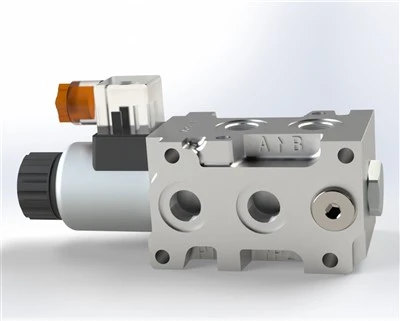 Solenoid-operated Directional Control ValveA solenoid valve is an automatic valve that uses an electromagnet to control the flow of fluid (such as liquid, gas, steam, etc.). It is a widely used component in various industrial automation andAdd to Inquiry
-
 The Buffer Valve 300 BarA buffer valve, also known as a cushion valve or deceleration valveAdd to Inquiry
-
 Hydraulic Valve Pilot Switching ValveHydraulic Proportional valves used with their associated electronic controls, also add the desirable features of acceleration and deceleration.Add to Inquiry
-
 Hydraulic Pilot Switching ValveHydraulic Proportional valves used with their associated electronic controls, also add the desirable features of acceleration and deceleration.Add to Inquiry
-
 System Valve Hydraulic Proportional ValveHydraulic Proportional valves used with their associated electronic controls, also add the desirable features of acceleration and deceleration. This offers a variety of machine cycles, safelyAdd to Inquiry
-
 YRS-5 pressure switch valve solenoid valve Hydraulic Prop...motor control valves are a crucial component in many modern industrial processes, enabling precise control and maximizing efficiency and reliability.Add to Inquiry
-
 YXD03-3 switch valve solenoid valve Orbital Steering Valv...The orbital steering valve is a vital component in many modern hydraulic systems. It is responsible for controlling the direction and flow of fluid, ensuring smooth and efficient operation. ThisAdd to Inquiry
-
 Hydraulic Valve For Road RollerThe hydraulic valve for a road roller is a crucial component that performs various functions to ensure the smooth operation of the machine. Its primary function is to regulate and control theAdd to Inquiry
-
 Electrical Solenoid Valve System ValveElectrical solenoid valve is a type of valve that utilizes electromagnetic forces to control the flow of fluids. It is commonly used in various industrial and household applications, includingAdd to Inquiry
-
 Hydraulic Micro Digger Pilot Operated Solenoid ValveThe microdigger pilot-operated solenoid valve is a highly effective and efficient valve that is designed to control the flow of fluids and gases in a wide range of industrial applications. This valveAdd to Inquiry


Sales1:
Fenella Han
Tel: +86-19811870497
Email: sales6@yikde.com
Sales2:
Cara Lee
Tel:+86-15863716397
Email: cara@yikde.com
Sales3:
Mia Yang
Tel:+86-19558677302
Email: sales5@yikde.com
Add: No.2998, Yihua Road, Tangcun Town, Zoucheng City, Jining City,Shandong province,China
Why Choose Us
Our product
The leading products are central rotary joint, Pilot Check Valve, Counterbalance Valve, Buffer Relief Valve, manual pump, diverter valve,2 ways flow divider, etc.
Our certificate
The company has been rated as a national high-tech enterprise, and a provincial "specialized, special and new" enterprise, and has passed the ISO9001 international quality system certification.
Production market
The domestic market share is in the forefront of the country, and it is popular in Europe, America, Southeast Asia, Russia and other countries.
Our service
The company also provides professional knowledge, technical guidance, technical services and timeliness to meet the changing market demand and customer requirements.

Hydraulic solenoid valve has a closed cavity, there are holes in different locations, each hole connected to different oil pipes, the middle of the cavity is the piston, the two sides are two electromagnets, which side of the magnet coil is energized valve body will be attracted to which side, by controlling the movement of the valve body to open or close the different drain holes, and the inlet hole is always open, the hydraulic oil will enter the different drain pipes, and then through the pressure of the oil to push the piston of the cylinder The piston drives the piston rod, and the piston rod drives the mechanical device, so that the mechanical movement is controlled by controlling the electric current of the solenoid.
Regarding the model of hydraulic solenoid valve, the arrangement of different models of different manufacturers is different. The meaning of hydraulic solenoid valve model, such as 34BYM-L20H-T, where 34 represents 3+4-way, B represents AC type, Y represents hydraulic pressure, M represents slide valve function, L represents threaded connection, 20 represents nominal diameter, H represents nominal pressure, H represents high pressure 31.5MPA, and T represents spring centering code.

Hydraulic Solenoid Valve Function
Hydraulic Pumps
Hydraulic pumps convert mechanical energy into hydraulic energy. They create the flow and pressure of fluid in a hydraulic circuit. A hydraulic solenoid can be used in pumps like a Variable Displacement Axial Piston Pump to control the volume of the hydraulic fluid output. These pumps use pistons to control the fluid flow. The solenoid is used to position a swashplate, which adjusts the positioning of the pump’s pistons. The change in piston position changes the volume of space available in the piston cavity for fluid to flow through. The greater the space, the higher the pump’s displacement will be.
Hydraulic Valves
A hydraulic valve controls the flow of hydraulic fluid by opening, closing, or partially obstructing pathways. Solenoids can be used as actuators in valves designed to control the flow, limit system pressure, or control direction. The example below shows a Directional Control Valve that uses two coils to control the positioning of a spool. The spool is pushed or pulled into position, opening and closing channels to change flow direction and volume.
Types of Hydraulic Solenoid Valves
Direct-acting solenoid valves: In direct-acting solenoid valves, the solenoid coil is directly connected to the valve body. When the solenoid coil is energized, it lifts the valve body, allowing fluid to flow through the valve. These valves are simple, reliable, and have a fast response time.
Pilot-operated solenoid valves: In pilot-operated solenoid valves, the solenoid coil is connected to a pilot valve, which controls the flow of fluid to the main valve. When the solenoid coil is energized, it opens the pilot valve, which in turn opens the main valve, allowing fluid to flow through the valve. These valves are used in applications where high flow rates and pressure differentials are required.
Two-way solenoid valves: Two-way solenoid valves have two ports an inlet port and an outlet port and are used to control the flow of fluid between these two ports. These valves are commonly used in applications such as on/off control, filling and draining of tanks, and control of hydraulic cylinders.
Three-way solenoid valves: Three-way solenoid valves have three ports an inlet port, an outlet port, and a common port and are used to control the flow of fluid between these ports. These valves are commonly used in applications such as diverter valves, mixing valves, and selector valves.
Four-way solenoid valves: Four-way solenoid valves have four ports two inlet ports, an outlet port, and a common port and are used to control the flow of fluid between these ports. These valves are commonly used in applications such as directional control valves, where the flow of fluid needs to be directed to different parts of a hydraulic system.
Choosing The Right Hydraulic Solenoid Valve
Oil flow rate
The quantity of oil flow in your application largely determines what size of valve you are going to use. You should also factor in the pressure drop of the flow medium across the valve in addition to its flow rate.
Valve material
The material used in making the valve should have qualities that are compatible with the hydraulic oil. Additionally, the properties of the material should not in any way react with the flowing media.
Pressure
The valve you settle for must be strong enough to shoulder the most extreme pressure that your application can offer. It should be able to function optimally in such conditions otherwise it will be a safety hazard.
Temperature
Ensure that your valve can operate efficiently within the maximum and minimum temperatures of your application. This is because temperature will also affect how viscous your flowing media will be and its flow rate.
Number of ports
The number of ports is determined basically by your application requirements. This will also tell how these ports are positioned on the hydraulic valve. More ports on your valve simply means increased chances for your selection flexibility. The manifolds in the solenoid valves are capable of sustaining many positions within a single valve.
Spool action
This is also determined by the method by which your application operates. After de-energization, some applications will require the spool to remain in place while others will need it to return to the center.
Manufacturing and industrial
Hydraulic solenoid valves are often utilized in automated assembly lines and process control systems. They facilitate the control of machinery and equipment, enabling automatic start-stop functions and regulating fluid flow rates. Such usage is critical in industries like food processing, textiles, and pharmaceutical manufacturing.
Automotive industry
Hydraulic solenoid valves are integral to automatic transmission and power steering systems. They regulate fluid flow, thereby controlling gear shifts and steering mechanisms. Similarly, in braking systems, they help modulate the hydraulic pressure, improving safety and reliability.
HVAC
Another notable application of hydraulic solenoid valves is in heating, ventilation, and air conditioning (HVAC) systems. Here, they control the flow of refrigerant, thereby influencing the cooling or heating process. This ensures optimal indoor climate control and energy efficiency.
Medical
The realm of medical equipment is not left untouched by these valves. They find their way into devices like dialysis machines and ventilators, where precise fluid control is paramount.
Components of Hydraulic Solenoid Valve
The electromagnet is an important part of the hydraulic solenoid valve. It generates a magnetic field by energizing the coil, so that the valve core moves and realizes the control function. The performance of the electromagnet directly affects the working reliability and response speed of the hydraulic solenoid valve.
The valve core is a key component in the hydraulic solenoid valve, which determines the control performance of the hydraulic solenoid valve. The valve core is usually made of steel material, and some special surface treatment technologies are used on the surface to improve its surface finish and wear resistance.
The valve body is the main part of the hydraulic solenoid valve, usually made of cast iron, steel or aluminum alloy. There are some channels and holes in the valve body to control the flow direction and flow rate of the medium.
The spring is an important part of the hydraulic solenoid valve. It is responsible for controlling the position of the valve core to ensure the control stability and accuracy of the valve. The pressure and stiffness of the spring are important parameters to ensure the normal operation of the hydraulic solenoid valve. Using springs with different stiffness under different working conditions can achieve different control effects.
The seal is an important part of the hydraulic solenoid valve. It can ensure that the medium does not leak during the flow process and can resist the corrosion and wear of the medium. Seals are usually made of high-strength materials, such as rubber, polyimide, etc., to ensure their sealing and durability.
How to Install a Hydraulic Solenoid Valve
The pipeline shall be washed clean before use. If the medium is not clean, a filter shall be installed to prevent impurities from interfering with the normal operation of the hydraulic solenoid valve.
The hydraulic solenoid valve is generally one-way and cannot be reversed. The arrow on the valve is the movement direction of the pipeline fluid, which must be consistent.
The hydraulic solenoid valve is generally installed with the valve body horizontal and the coil vertical upward. Some products can be installed at will, but it is better to be vertical when conditions permit to increase the service life.
The hydraulic solenoid valve shall be heated or provided with thermal insulation measures when it is re-operated in an icy place.
After the outgoing line (connector) of the solenoid coil is connected, confirm whether it is firm. The contact of the connecting electrical components should not shake. Looseness will cause the hydraulic solenoid valve to not work.
For the hydraulic solenoid valve to be continuously produced and operated, it is better to use bypass to facilitate maintenance and not affect production.
The hydraulic solenoid valve that has been out of service for a long time can only be used after the condensate is discharged; During disassembly and cleaning, all parts shall be placed in order and then restored to the original state.
Hydraulic Solenoid Valve Troubleshooting
The push rod becomes short in the wear of the solenoid tube
When the armature moves, the push rod in the solenoid valve is used to push the spool movement. Push-rod and spool are not integrated; Therefore, in continuous contact, it is bound to cause wear. After a long period of high-load impact, it may wear out and become significantly shorter. At this point, the spool has not been installed in place, which will affect the operation of the directional solenoid valve. Just put the putter back in and solve the problem. Here, it is important to note that the size of the new putter you purchase should be the same as the original size.
Solenoid coil damage (normal combustion)
The combustion of electromagnets is also one of the common faults of hydraulic solenoid valves. The reason for this situation is generally the quality of the hydraulic solenoid valve itself, such as the poor processing of the valve core of the hydraulic solenoid valve , and the diameter of the wire being too small, it is not easy to overheat. The failure caused by its quality problems can usually be noticed within a few hours after the hydraulic solenoid valve is energized. After working for a while, the solenoid valve coil failure is mostly caused by environmental reasons.
Spool outer diameter wear
Same wear as the holes in the valve chamber. Especially in the case of excessive impurities in the oil, excessive pollutants will exacerbate the wear of the solenoid valve slide valve. Although we cannot completely avoid such wear, we can extend the service life of the hydraulic solenoid valve and maintain good working conditions. This requires us to regularly check the cleanliness of hydraulic oil, and to deal with excessive pollution of hydraulic oil.
Fatigue or fracture of the reset spring
This type of failure has a specific relationship with the material choice of the spring. Select an imported high wire spring, the surface is black, with good elasticity and fatigue resistance. Strengthening the surface treatment process can effectively prevent spring corrosion, and long service life. If such a failure occurs, both springs must be replaced at the same time, and the length must match the design of the hydraulic solenoid valve.
Disassembly
Although various parts of the hydraulic solenoid valve are connected using bolts, the design of the hydraulic solenoid valve is not intended for disassembly. If there is no specialized equipment or professional technology, forced disassembly is highly likely to cause damage to the hydraulic solenoid valve. Therefore, we need to grasp the structure of the hydraulic solenoid valve and the connection type between parts before disassembly. When disassembling, record the position relationships between various parts.
Assembly
Assemble according to the hydraulic solenoid valve assembly diagram or the parts assembling relationships recorded during disassembly. Be careful not to damage parts during assembly. The original sealing material is easily damaged during disassembly and should be replaced during assembly.
Rough wash
Put valve body, valve core, and other parts on the tray of the cleaning tank. Through heated soaking, press the compressed air into the bottom of the cleaning tank. Through the stirring effect of the bubble, clean the residual filth. If conditions permit, ultrasonic cleaning can be used.
Fine wash
Use the cleaning solution to do high-pressure positioning cleaning and dry with the hot wind in the end. If conditions permit, companies can use existing cleaning solutions. On individual occasions, organic cleaning solutions such as diesel and gasoline can be used.
Check and clean-up
Check the filth deposition situation of the valve body, valve core, and other parts. Without damaging the work surface, clean the filth using cotton yarn, brush, and non-metallic scraper.
FAQ
Shandong Yikaide Hydraulic Co., Ltd. is one of the most professional solenoid operated diverter valve manufacturers and suppliers in China, specialized in providing high quality products and service. We warmly welcome you to buy customized solenoid operated diverter valve made in China here from our factory.
Hydraulic Solenoid Directional Valve, Hydraulic Electric Directional Valve