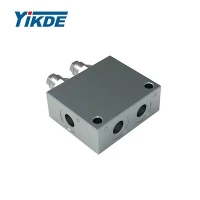
As a supplier of Pilot Check Valves, I often get asked about the electrical requirements for these nifty little devices. So, I thought I'd take a few minutes to break it down for you.
Do Pilot Check Valves Need Electricity?
First things first, let's clear up the big question: do pilot check valves actually need electricity? Well, the short answer is, it depends. Traditional pilot check valves are mechanical devices. They work based on hydraulic pressure and don't rely on electricity at all. These valves are designed to allow fluid to flow in one direction freely, but when the pressure tries to reverse, they'll block the flow until a certain pilot pressure is applied.
This mechanical design makes them super reliable in many hydraulic systems. You don't have to worry about electrical failures or power outages affecting their operation. They just do their job, day in and day out, as long as the hydraulic system is functioning properly.
Electrically - Controlled Pilot Check Valves
However, there are also electrically - controlled pilot check valves out there. These are a bit more advanced and offer some extra functionality. In an electrically - controlled pilot check valve, an electric solenoid is used to control the pilot pressure.
The solenoid is basically an electromagnet. When you apply an electric current to it, it creates a magnetic field that moves a plunger. This movement can either open or close the valve, depending on the design. This gives you more precise control over when the valve opens and closes, which can be really useful in complex hydraulic systems.


Electrical Requirements for Electrically - Controlled Valves
If you're using an electrically - controlled pilot check valve, there are a few electrical requirements you need to keep in mind.
Voltage
The first thing is the voltage. Different valves are designed to work with different voltages. Common voltages include 12V, 24V, and 110V. You need to make sure that the voltage of your power supply matches the voltage rating of the valve. If you use a voltage that's too high, you could damage the solenoid. On the other hand, if the voltage is too low, the solenoid might not be able to generate enough force to operate the valve properly.
Current
Along with voltage, you also need to consider the current. The current rating tells you how much electrical current the solenoid will draw when it's powered on. You need to make sure that your power supply can provide enough current to operate the valve. If the power supply can't deliver enough current, the solenoid might not work at all, or it could overheat and fail.
Duty Cycle
The duty cycle is another important factor. It refers to the amount of time the solenoid can be powered on without overheating. Some valves are designed for continuous operation, which means they can be powered on all the time. Others have a limited duty cycle, say 50% or 70%. This means that if the duty cycle is 50%, the solenoid can only be powered on for half of the time. If you use the valve beyond its duty cycle, the solenoid will overheat and eventually break down.
Why Choose Electrically - Controlled Pilot Check Valves?
You might be wondering why you'd even bother with an electrically - controlled pilot check valve when the mechanical ones work just fine. Well, there are a few good reasons.
Automation
One of the main advantages is automation. In modern industrial settings, automation is key. With an electrically - controlled valve, you can easily integrate it into an automated control system. You can use sensors and controllers to monitor the system and open or close the valve as needed. This can save a lot of time and labor, and it can also improve the accuracy of the system.
Remote Control
Another benefit is remote control. If you have a hydraulic system that's in a hard - to - reach place, or if you need to control the valve from a different location, an electrically - controlled valve is the way to go. You can use a wired or wireless connection to send electrical signals to the valve and operate it remotely.
Related Products
If you're in the market for other related valves, we also offer a range of options. Check out our Relief Valve, which is designed to protect your hydraulic system from over - pressure. Our Hydraulic Buffer Valve SHC helps to reduce shock and vibration in the system. The Orbital Hydraulic Motor Safety Valve is crucial for protecting your hydraulic motor. You might also be interested in our Buffer Valve and Hydraulic Parts Buffer Valve, which play important roles in maintaining the stability of your hydraulic system.
Let's Talk Business
Whether you're looking for a traditional mechanical pilot check valve or an electrically - controlled one, we've got you covered. Our products are of high quality and have been tested rigorously to ensure they meet the highest standards. If you're interested in learning more about our pilot check valves or any of our other products, feel free to reach out. We're always happy to have a chat about your specific needs and see how we can help you get the right valve for your application.
References
- "Hydraulic Systems Handbook" by some well - known hydraulic expert.
- "Valve Technology and Applications" from a leading valve industry publication.